
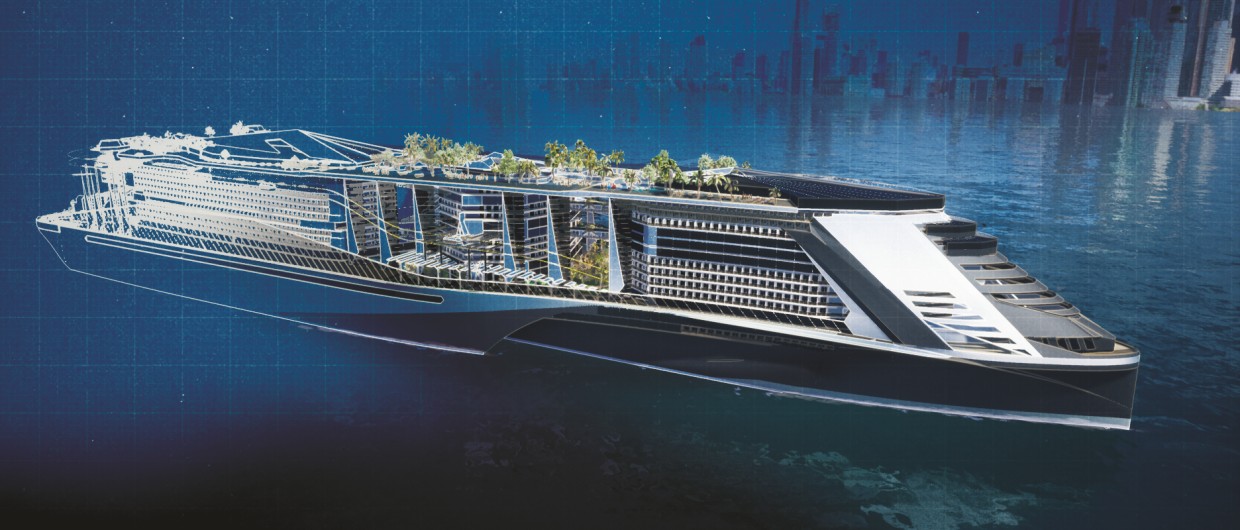
MANTA RAY - THE SHIP AS A DESTINATION
Creating innovations through new ways of thinking and questioning, breaking up and overcoming the familiar structures - that was the starting point for our Manta Ray concept study.
It became a design concept that is outside the usual technical comfort zone and takes on the challenge of ever larger ships. The core of our approach involved making the cruise ship itself even more of a holiday destination while being as climate-friendly as possible.
Since the ship itself was to be the destination, the width of the ship did not have to be oriented towards common ports. It would mainly travel on the ocean and anchor off the ports. So in the end, a ship with a width of 88 metres and a length of 454 metres was created. Various hull models led the concept team to three hulls: the idea of a trimaran with a gross tonnage of 431,000 GT was born and a good compromise between hydrodynamic efficiency and maximised deck area was found.
In order to still offer the large number of passengers - up to 10,000 could travel on board - the feeling of individuality and various possibilities for retreat, the designers and engineers relied on many decentralised public areas. The idea was not to have one big theatre for everyone, but to have a wide variety of offerings comparable to a metropolis - from the centre, where life pulsates, to the small suburbs, where things are more tranquil but where there are still extraordinary places and hidden areas to discover.
On the lower decks 10 and 11, there is a large promenade deck with a central wind-protected parking area. Rotating vertical louvres allow either fresh air or weather protection, individually adjustable according to need and travel region. In addition, the vertical louvres minimise the ship's wind resistance during the voyage.
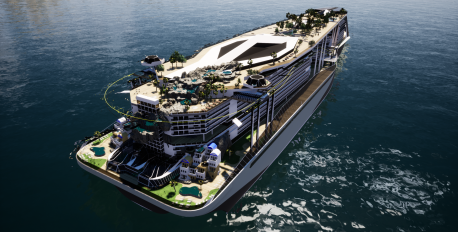
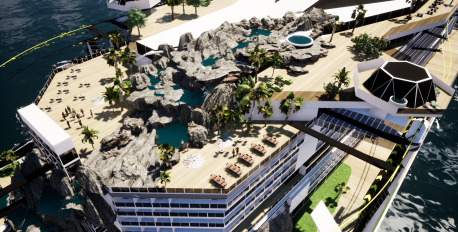
From deck 23 to deck 15, rocks connect different themed worlds that can be explored rapidly by canyoning, as a mountain stream meanders through the rocks and ends as a waterfall in the solarium. There is also a deep-sea diving pool that begins on deck 23 and extends to the Lido restaurant on deck 20. The restaurant has two decks and is directly connected to the entertainment area "The Cave", which is based on the architectural style of the Lanzarote architect and artist César Manrique (1919-1992), whose main characteristic is the integration of rocks and nature into a harmonious living space.
Thematically and architecturally, the upper decks at the stern are connected to the promenade deck on deck 11 by terraces offset in height and hidden retreats. The design here is inspired by the island of Santorini.
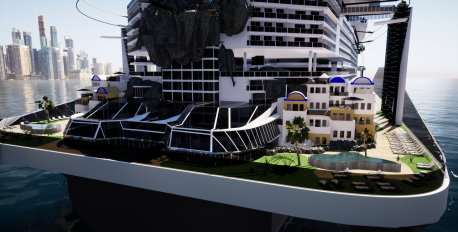
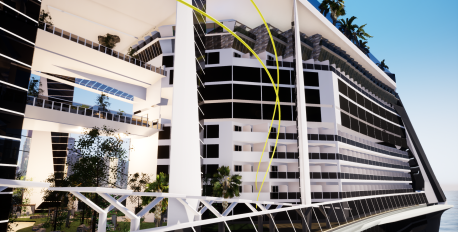
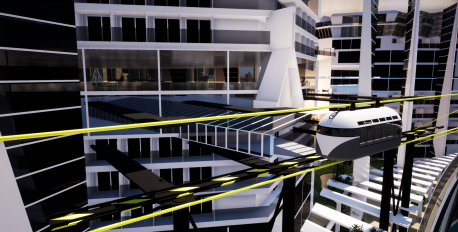
The general "ship-within-a-ship" approach, i.e. the arrangement of passenger areas on different decks and zones, presented the design team with the challenge of making the different areas efficiently accessible for the passenger and crew members. This was the birth of the "People Mover", which travels along a fixed route with defined stops to the different main areas of the ship. This provides passengers with mobility on board that would not be possible with normal staircases or on foot given the size of the ship.
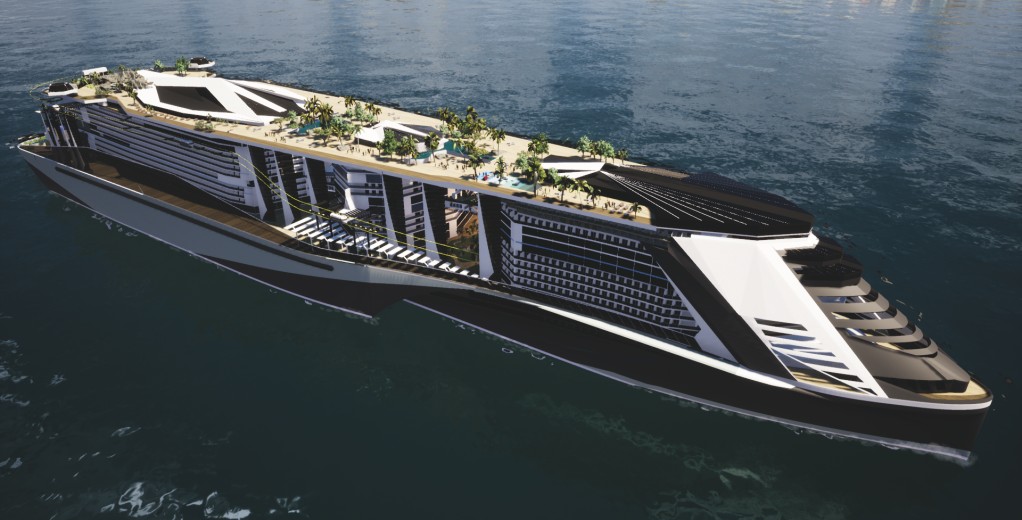
The technical components, as well as the design of all areas necessary for operation, have been rethought with regard to sustainability and resource-saving use. For example, the propulsion system is to be powered exclusively by fuel cells, and the location of the rooms necessary for the ship's operation was redesigned to keep walking and transport distances as short as possible. The result of these considerations is a centralised and almost completely automated main kitchen, which can transport the food directly and without delay to the respective restaurants via a special conveyor belt and lift system. This central area of the ship is connected to a newly developed provisioning area. An automated container loading system not only enables the ship to be loaded and unloaded quickly, but also allows the containers to be loaded with the required ship's goods in advance on land.
The idea behind the Manta Ray concept design is to find solutions to optimise the cruise ship of the future and to take into account the technological developments and megatrends of the next decades.